

Farm & Field Report
Farm Bureau President’s Trip
Submitted by: Michael K. Miller
Each year the Henry, Fulton, Williams, and Defiance County Farm Bureaus send representatives to Washington D.C. for what they call the President’s trip. The individuals attending could be a President, Vice President or county representative of each County’s Farm Bureau and represent all 88 of Ohio’s Counties. We met with the President of the Ohio Farm Bureau Bill Patterson and President of the American Farm Bureau Zippy Duvall. Mr. Duvall was our keynote address speaker, followed by speeches from Senator Bernie Moreno and Senator Jon Husted. After that meeting, we then were to meet with one of our local Representatives which was to be Rep. Marcy Kaptur, however, Rep. Kaptur was not in that day and we met with her Aids instead. Some Issues discussed were Trade with the E.U., the Farm Bill, data centers, Fertilizer Co. monopolies, and regulations to the SNAP and school lunches programs and how they are attached to the Farm Bill and affect it. One of the main big topics that was discussed was about data centers and how the government wants to promote data or AI, and how you can control the data centers on the local level with zoning ordinances and taxes. This was some of the main reasons we were sent to Washington D.C., to lobby for these issues and more and to make our Representatives in Washington aware of the issues concerning farmers.
This year’s Farm Bureau President’s Trip was from March 10 thru March 12, 2026.

When to Plant Ohio Soybeans | Invested in Your Future
Ohio Soybean Council
Incremental Improvements in the Quality Water Quality of Lake Erie
by: Dusty Sonnenberg, CCA, Field Leader, a project of the Ohio Soybean Council and Soybean Checkoff

The improvements in water quality in Lake Erie have been noteworthy in recent years. Ever since the Toledo water crisis of 2014, farmers and the agricultural industry have been under a microscope, both literally and figuratively. Greg LaBarge, field specialist, agronomic systems with OSU Extension, has been studying nutrient management impacts on crop production and water quality.
“We have good news in that things are improving,” LaBarge said. “We are seeing that the dissolved reactive phosphorus going into the lake is down about 10%. Our goal is a 40% reduction, so we have not gotten all the way to our goal yet.”
While the dissolved reactive phosphorus level in the lake still has room for improvement, the toxic component of the harmful algal bloom has decreased.
“We have also seen the cyanobacteria, which is the harmful part of the algal bloom, has decreased in intensity,” said LaBarge. “The goal is 9 out of 10 years to have a level that is less than a three on a zero to 10 scale, with zero being ideal. At this point, we are at 5 out of 10 years.”
Farmers have been paying attention to the water quality issue and are doing their part to implement best management practices to reduce these levels.
“I think from a nutrient management standpoint, we are doing really great work reducing the amount of phosphorus that is applied to the fields,” LaBarge said. “By cutting back our rates, we are reducing one source of potential loss when we make those fertilizer applications. The second thing we accomplish is that we are now removing even more phosphorus from the grain because we continue to increase yields. By reducing the amount of phosphorus going on, and continuing to increase our yields, we result in a net reduction in the amount of phosphorus that is being stored in the soil. Less phosphorus in the soil leads to less phosphorus losses when we have the rainfall events that lead to drainage flows in the watershed, so now we have less phosphorus coming off the fields.”
Given the current cost of fertilizer, reducing fertilizer applications and rates is also an economic win for farmers.
“At $850 a ton, MAP is one of our more expensive nutrients. From an economic standpoint, it makes sense to put less phosphorus down. Agronomically, we see that we have been able to manage that and see that soil test phosphorus will stabilize in the soil, and we have a good buffering capacity in that case,” LaBarge said. “We also see that there is not necessarily a crop response all the time when we apply fertilizer. We are starting to understand where the sweet spot is in relation to economics and understanding crop yield increases from phosphorus and how we go about achieving better economics for nutrient management.”
Research will continue in fertility management and water quality as it applies to Lake Erie.
“In 2026, we are going to start focusing more on what is in the soil as far as the phosphorus. The idea of water management is to try to keep water contained in the field or filter it before it leaves. This is going to be important as we try to deal with the chronic source of phosphorus in any basin across the state of Ohio,” said LaBarge. We are going to see practices like wetlands needing to be put in place, and possibly drainage water recycling, two-stage ditches, and anything that will start to slow down water, so it infiltrates into the soil.”
Article posted by permission. Original article can be found here.
Top-Dressing Wheat with Liquid Manure
By Glen Arnold, Ohio State Extension

Wheat fields will be firming up across Ohio and spring top-dressing with nitrogen fertilizer will soon start. Livestock producers and commercial manure applicators may be considering applying liquid manure as a top-dress fertilizer for wheat.
The key to applying the correct amount of manure to fertilize wheat is to know the manure’s nitrogen content. Most manure tests reveal total nitrogen, ammonia nitrogen, and organic nitrogen amounts. The ammonia nitrogen portion is readily available for plant growth. The organic nitrogen portion takes considerably longer to mineralize and generally will not be available when wheat takes up the majority of its nitrogen before mid-June.
Most deep-pit swine finishing manure will contain between 30 and 40 pounds of ammonia nitrogen per 1,000 gallons. Finishing buildings with bowl waterers and other water conservation systems can result in nitrogen amounts towards the upper end of this range. Finishing buildings with fixed nipple waters and surface water occasionally entering the pit can result in nitrogen amounts towards the lower end of this range. The contents of the ration fed to the pigs can also affect manure nitrogen numbers, so don’t guess-have a manure test.
In past years, some farmers have used sow manure to top-dress wheat. Just know the nitrogen amount in sow manure will be much lower than swine finishing manure, so adjust application rates accordingly or make up the needed nitrogen with a second application of sow manure or by applying commercial nitrogen.
Dairy manure can also be used to top-dress wheat, but it will not produce a full grain yield compared to commercial fertilizer or swine manure. It will produce suitable growth of the crop for a harvest of wheat silage. I have watched dairy manure being applied at Feekes growth stage 7, and the wheat plants handled the drag hose flattening without issues, although the tractor wheel tracks were clearly evident.
In university research, we have used both manure tankers and drag hoses when top-dressing wheat. The concern with manure tankers is soil compaction, especially on heavy soils. The drag hose seemed to work well wherever it was used.
The typical application rate for liquid swine finishing manure on wheat is 4,000 gallons per acre. Wheat removes 0.49 pounds of P2O5 per bushel harvested. When also harvesting the wheat straw, a ton of wheat straw contains between three and four pounds of P2O5. So, a 100 bushel wheat crop with one ton of straw also removed would withdraw about 52 pounds of P2O5 per acre. This is likely about the same amount of P2O5 as 4,000 gallons of swine finishing manure would contain, but review your manure test to make this determination.
When applying livestock manure to wheat, it’s recommended to follow the NRCS #590 Waste Utilization Standard to minimize potential environmental impacts. This standard includes a 35-foot-wide vegetative strip setback from ditches and streams. Applicators in the Western Lake Erie Basin also need to look at the weather forecast to be certain there is not greater than a 50 percent chance of more than a half-inch of rain in the 24 hours following manure application when surface applying. Print this forecast so you have proof in the event of a surprise rain downpour.
Article posted by permission. Original article can be found here.
What Factors Should Be Considered Before Early Soybean Planting in Ohio
by: Dusty Sonnenberg, CCA, Field Leader, a project of the Ohio Soybean Council and Soybean Checkoff
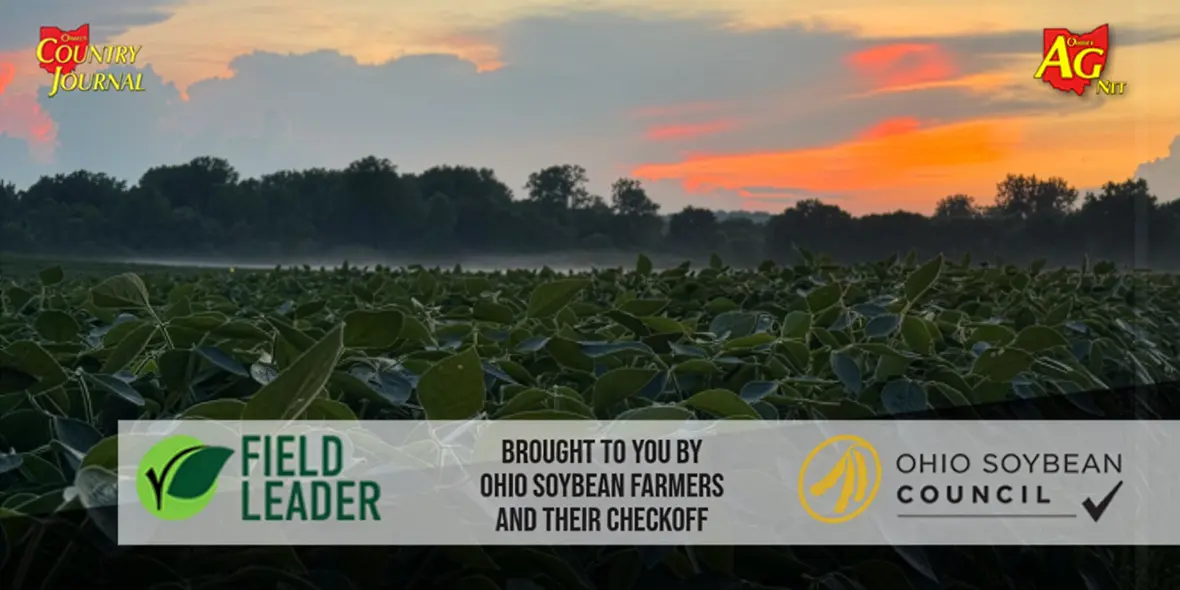
When planting soybeans early, there are many factors a farmer should consider before heading to the field.
For years, the prevailing school of thought when it came to soybean planting dates focused on the last killing frost and planting in a timely fashion so the beans would not emerge too early and then be killed by that frost. For soybeans, the growing point of the plant is above the ground once the seedling emerges. This exposes it to damage or death from the cold temperatures. This is different from corn or wheat, where the growing point remains below ground until later stages of plant development. While the concept of avoiding a hard freeze/killing frost remains true for soybeans, several other factors are now considered by growers when making their soybean planting decisions. Among those are crop insurance, early planting/replant dates, seed company replant guarantees, and new research on plant populations and final yields.
According to the USDA, approximately 77% of Ohio farmers purchase crop insurance. In 2023, the USDA Risk Management Agency (RMA) adjusted the early planting date, allowing farmers to plant earlier and still have coverage. Crops planted before the specified earliest planting date are not eligible for replanting payments. That date is based on the county where the field is located. Generally speaking, in northern Ohio, the date is April 15. In parts of central Ohio, it is April 10, while in some parts of southern Ohio, it is as early as April 5. Some crop insurance companies also offer additional early replant coverage riders. Growers need to check with their crop insurance providers for specific details.
Many seed companies have seen yield benefits for farmers who choose to plant early. Those companies now offer various replant guarantee options based on the seed purchased. These are specific to the company and may have additional requirements. Growers should check with their seed dealers to understand if replant guarantees exist and how they work.
In Beck’s Practical Farm Research, they found that earlier planting dates allow the plant to add additional nodes and capture more sunlight in May. In general, they observed three to five more nodes per plant with early planting, which they say is one of the key components of yield in soybeans. They recommend planting early and deep enough to ensure consistent moisture to synchronize emergence. In their four-year multi-location planting date study, the highest yields were achieved when soybeans were planted between April 16 and May 15. Yields for beans planted between April 1 through April 15 were similar to those planted between May 16 through May 31. The planting date, seeding rate, row spacing, and relative maturity of the beans were also factors that should be considered.
Research conducted by Taylor Dill, a graduate student working with Laura Lindsey, Ph. D., at The Ohio State University through the OSU Extension Battle for the Belt project, also examined several factors when evaluating planting dates and their impact on final yields.
“In our Battle for the Belt project, the sites located in southern Ohio are where we saw the most freeze damage occur,” Dill said. “In northern Ohio, often when we plant early, it is still wet and cold, and it takes much longer for the plants to emerge. One positive to a plant not emerging early is that it is protected from the freezing temperatures because there is a layer of soil to protect the seed. What we observed in southern Ohio was that there were warmer soil temperatures and the plants emerged a little quicker than in other parts of Ohio. That does add a little bit of risk when it comes to freeze damage.”
A freezing event does not necessarily mean a total crop loss.
“What we have seen with freeze events in my research is that even with a freeze and an early planting date, you can still optimize yield even with that early planting and a little bit of stand loss risk,” Dill said. “You may have some weed management concerns with that stand loss, so you want to make sure that you are prepared for that.”
Having a uniform plant stand, even if the population is lower than desired, is the key. Plant stand uniformity can be difficult to measure, but it can make up for population losses.
“Most of the time, when it came to planting population, we did not see much of a difference based on planting date. If you are planting really early and you notice a stand loss, it is important to keep in mind that our goal is to have 100,000 plants per acre,” Dill said. “I do not want to encourage less than that. If a grower wants to bump up their seeding rate a little bit, especially if they are trying to plant early, before that frost date, it may give you a little bit more peace of mind.”
The extremes will get your attention.
“Most farmers would be surprised that even with some initial stand loss, they are going to probably be okay with the final yield,” Dill said. “A severe freeze or frost may flatten their field. It is a real possibility, and they need to be aware of it. But from what we have seen in our research, even with the stand loss, early planting can be worth it.”
Tillage practices can also make a difference, according to Dill, when it comes to early planting soybeans and a frost/freeze risk.
“At our Western research location, there were two different projects being conducted. Both were planted on the same date and in the same soil type. One was planted in no-till, and the other was in conventional tillage. There was a freeze event, and the tillage soybeans lost fewer beans,” Dill said. “In the no-till situation, there was more seedling death from the frost than compared to the tilled situation. Likely it was from the heat in the warmer tilled soil that was not there in the no-till situation. If you are looking at no-till or cover cropping, I would recommend being cautious about very early planting dates because some of those same issues could arise. We have research in our lab as well that shows similar interactions with cover crops and no-till in that situation.”
Article posted by permission. Original article can be found here.
Help us Shape the Future
The C-FARM (https://carbon.osu.edu/c-farm) research team is farmers, landowners, or other decision-makers managing cropland or farmland to participate in a comprehensive survey focused on carbon markets. Your responses will help researchers understand the challenges, questions, and information gaps that influence participation in agricultural carbon programs, ultimately guiding future outreach and extension efforts.
How to Participate:
Completing this Qualtrics survey will take 10-12 minutes. Ohio Farmers can complete the survey online by October 31, 2026. Completing the survey constitutes your consent to participate in the study.
As a token of appreciation for your time, Ohio Farmers who complete the survey will receive a $10 virtual gift card. Please remember to include your full name and email address at the end of the survey so we can send the gift card.
If you plan to attend the Conservation Tillage and Technology Conference, you can also participate in this survey on site. Visit us March 10–11, 2026, at the OSU Soil Health and Water Quality booth at CTTC from 9:00 a.m. to 5:00 p.m.
Link to access survey: https://osu.az1.qualtrics.com/jfe/form/SV_4Iuy6p1dfEotUwu

Figure 1: Explains what the Agricultural Carbon Cycle is (Created by Fariba Babaeian and Asmita Murumkar)
QR for survey:

Inquiries with questions about the survey or its use should be directed to Michael Estadt, estadt.3@osu.edu, Prasanna Oruganti, oruganti.11@osu.edu, Elizabeth Hawkins, hawkins.301@osu.edu, Asmita Murumkar, murumkar.1@osu.edu
Funding source: This Project is funded by “The Foundation for Food and Agriculture Research (FFAR).”
Principle Investigator(s): Michael Estadt, Prasanna Oruganti, Dr. Elizabeth Hawkins, Dr. Asmita Murumkar.
Crop Observation and Recommendation Network
C.O.R.N. Newsletter is a summary of crop observations, related information, and appropriate recommendations for Ohio crop producers and industry. C.O.R.N. Newsletter is produced by the Ohio State University Extension Agronomy Team, state specialists at The Ohio State University and the Ohio Agricultural Research and Development Center (OARDC). C.O.R.N. Newsletter questions are directed to Extension and OARDC state specialists and associates at Ohio State.
Author(s): Prasanna Oruganti, Elizabeth Hawkins, Asmita Murumkar
Ohio Soybean Checkoff funded research, now and in the future
By Dusty Sonnenberg, CCA
Field Leader, a project of the Ohio Soybean Council and Soybean Checkoff
The Soybean Checkoff was formed as a part of the 1990 Farm Bill, and the Ohio Soybean Council was founded in 1991 to manage soybean promotion and research projects. For 35 years, those checkoff dollars have been farmer-directed to fund research projects helping growers improve production practices and increase yields. Today, that research is overseen by Taylor Dill. Dill began her role as the OSC Director of Research in January.
“I’m really excited to be here and get started working with Ohio farmers,” Dill said.
Ongoing research funded by the checkoff is exploring planting practices, the use of new technologies, weed control, and disease management.

“My Ph.D. research project was a checkoff-funded program,” Dill said. “It is called Battle for the Belt, Corn versus Soybeans. Which crop should be planted first? We have three locations across Ohio. One is in Wood County, one is in Wayne County, and the third is in Clark County. In the study, we plant corn and soybeans on the exact same dates. We selected five planting dates each year for the past three years. 2025 was our wrap-up season.
“The main research question we are asking with planting date priority is which crop should be the priority if planting is delayed? Which crop can handle that delay the best? Which crop is going to have the least yield reduction, and possibly miss more stressors during the season? It factors in all those interactions,” Dill said.
Artificial Intelligence (AI) has quickly become a part of daily life. It is also being investigated and applied to production agriculture.
“Dr. Scott Shearer is focusing on AI and using data sets to identify soybean crop stressors and look at cost-effective mitigation of that stress,” Dill said. “He uses compilations of data to be able to accomplish that. I think it is really encouraging that they are building data sets that are applicable to us and that are useful to production agriculture.”
New drone technologies with aerial imagery are being used to provide input. This can help farmers answer one of the most difficult questions they face annually when making replant decisions.
“This is a project I know pretty intimately because I worked on it as a Ph.D. student,” Dill said. “When we look at soybean replanting, we want to have uniformity. A newly emerged soybean population can be low, but if you have uniformity, then the farmer does not need to replant. Unfortunately, uniformity is not well defined. What is the perfect measurement between plants? These are questions we do not know the answer to. With the use of drones, the idea is to map out the field, analyze the population and plant spacing, and give a recommendation on replant decisions.”
Developing those recommendations requires extensive field-level data and precise measurements.
“The researchers were literally on their hands and knees measuring the inches in between soybean plants to be able to feed the AI and tell it how to measure uniformity within the soybeans,” Dill said. “It is amazing to consider all the back-end computer work they need to do to look at all their pictures and make sure it is correctly identifying a soybean and that it is not identifying a weed. It is impressive, and a lot goes into it. The AI also must learn what the bean looks like.”
The goal is to move that detailed research into practical, in-season tools for farmers.
“These images and models are important so that when a soybean plant is competing with a ragweed early in the season, and we fly a drone over it, the AI knows which is which,” Dill said. “They are teaching what the soybean looks like. This is how far apart we want them to be. If they’re not this far apart, then the farmer should consider replanting the field. I think it is an exciting and useful tool that they are going to develop with this research.”
Soybean cyst nematode remains one of the most significant yield-limiting pests for Ohio soybean growers.
“OSU Extension Soybean Pathologist and Nematologist, Dr. Horacio Lopez-Nicora, has a SCN mapping project he is currently working on,” Dill said. “Thanks to funding from the Ohio Soybean Council through the soybean checkoff, Ohio soybean growers can get a free soybean cyst nematode sample. Dr. Lopez-Nicora’s lab will analyze the sample for SCN and give you an egg count for your field. The locations are mapped so we can better understand the levels of soybean cyst nematode across the state and be able to mitigate their risk at the farm level. This research project gives us really valuable information and will help guide us on where we should put further research within soybean cyst nematodes.”
Ohio Farm Bureau Members gathered at the Ohio Statehouse
A large contingent of Ohio Farm Bureau members gathered at the Ohio Statehouse in Columbus Feb.18 for the organization’s annual Ag Day at the Capital, meeting one-on-one with state legislators and staff to discuss policy priorities impacting Ohio’s farms and rural communities.
During the event, Ohio Farm Bureau unveiled its 2026 priority issues, including the preservation of Ohio’s farmland, smart and sound land use legislation, transparency and uniformity on the critical Current Agricultural Use Value (CAUV) program, and further investment of Ohio’s food supply chain. Members also discussed a range of community-specific and agriculture-related issues with their representatives and leaders.
“The priority issues laid out by our members, through our grassroots policy process, provide a blueprint for leaders and policymakers to bolster and support Ohio’s agriculture industry and our rural communities,” said Jack Irvin, vice president of public policy with Ohio Farm Bureau. “Being able to convey these important messages directly with lawmakers is something that our members don’t take for granted, and to be able to give them access to do that is a prime example of what this organization is all about.”
Through meetings with lawmakers, members advocated in support of House Bills 575 and 646. Introduced by Reps. David Thomas and Bob Peterson, HB 575 brings many small, needed changes and uniformity to CAUV, while HB 646, introduced by Reps. Kellie Deeter and Gary Click, creates a statewide study commission on the impacts of data centers, the environment and other related issues. Both pieces of legislation are aligned with Ohio Farm Bureau policy and would further support Ohio agriculture.
Ag Day attendees also heard from American Farm Bureau Vice President of Public Policy and Economic Analysis John Newton, Ph.D, Ohio Farm Bureau President Bill Patterson and Ohio Farm Bureau Executive Vice President Adam Sharp.
Ohio Farm Bureau’s mission is working together for Ohio farmers to advance agriculture and strengthen our communities. Learn more at ohiofarmbureau.org
This is a news release for use by journalists. Questions should be directed to Ryan Matthews, 614-246-8210 or rmatthews@ofbf.org